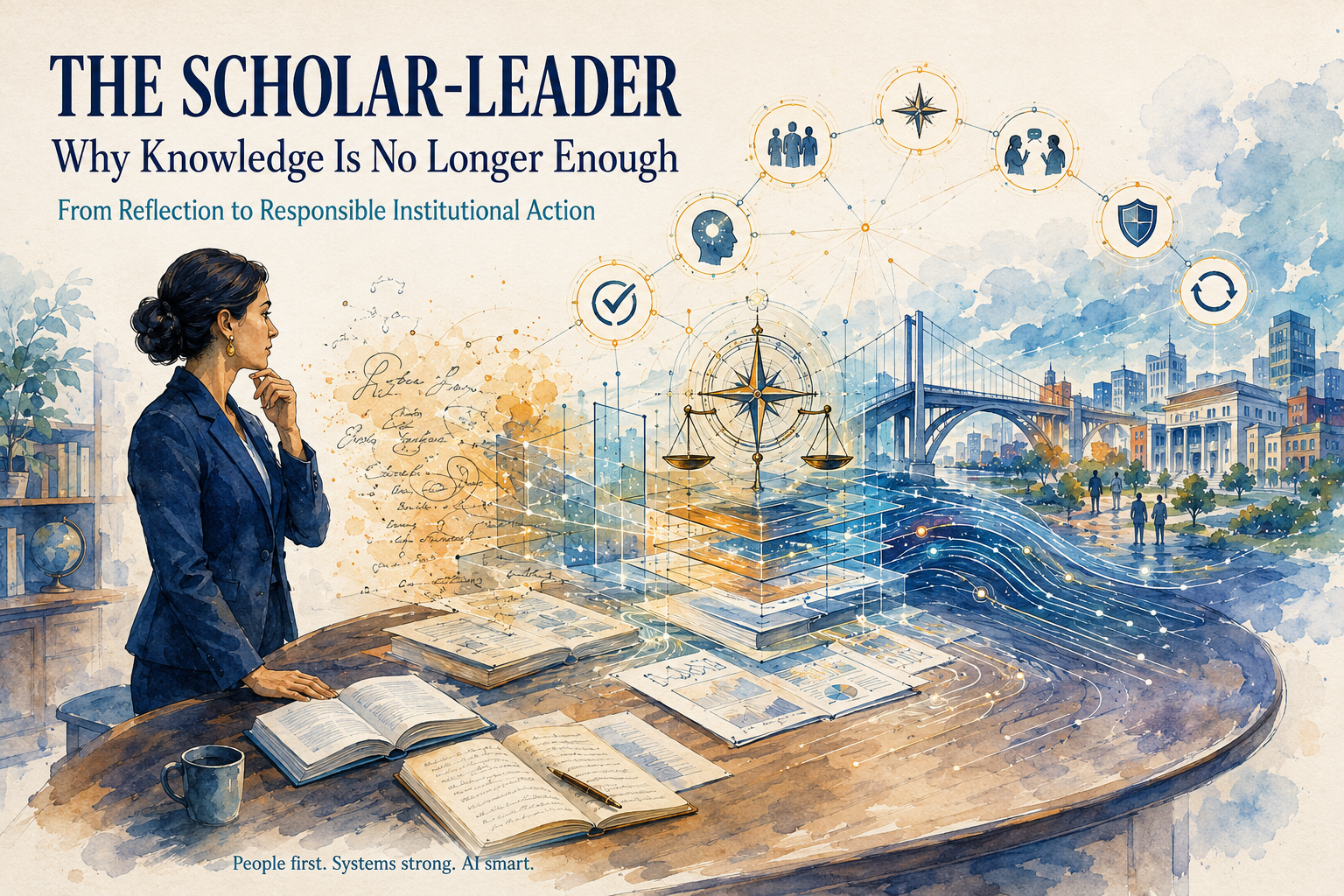
The Scholar-Leader: Why Knowledge Is No Longer Enough
In the AI era, institutional advantage depends on converting insight into human agency, accountable decisions, workforce capability, and resilient action.
Executive Introduction
Artificial intelligence is moving from experimentation into institutional infrastructure. The 2026 Stanford AI Index reports that organizational AI adoption reached 88 percent in 2025. Yet the same report recorded 362 documented AI incidents—up from 233 in 2024—and found a 50-point divide between AI experts and the public over whether the technology will improve work. Capability, adoption, safety, and trust are not advancing at the same speed.
The workforce is equally unsettled. The World Economic Forum’s Future of Jobs Report 2025 found that 86 percent of surveyed employers expect AI and information-processing technologies to transform their businesses by 2030. However, 63 percent identified skills gaps as a barrier to transformation, while 46 percent cited organizational culture and resistance to change.
This is not simply a technology-management problem. It is a leadership problem: speed versus resilience, automation versus human agency, experimentation versus accountability, and immediate efficiency versus long-term institutional legitimacy.
The NIST Generative AI Profile offers organizations a cross-sector framework for incorporating trustworthiness throughout the design, development, use, and evaluation of AI systems. But frameworks produce value only when leaders embody their principles in decisions.
Successful institutions will therefore require more than informed executives. They will require scholar-leaders: people capable of turning reflection into judgment, judgment into governed action, and experience into institutional learning. Knowledge becomes strategic only when it changes who has authority, how risk is escalated, how people are protected, and what the organization does differently next time.
Eight Strategic Points
1. Human Agency Is the First Control
Automation should expand human judgment, not erase human agency.
Every transformation affects someone’s authority, dignity, livelihood, privacy, or ability to challenge a decision. A system may be technically accurate and still be institutionally harmful if employees, customers, patients, or citizens cannot understand its role, contest its output, or reach an accountable human decision-maker.
The OECD AI Principles, updated in 2024, place human rights, fairness, privacy, transparency, robustness, and accountability at the center of trustworthy AI. These are not abstract values. They determine whether people experience technology as assistance, surveillance, exclusion, or coercion.
Boards should require an explicit human-agency assessment for every material AI use. Who is affected? What authority has been delegated? Which decisions require human review? What appeal or correction mechanism exists? Who bears the consequences when the system is wrong?
Organizations should measure more than accuracy and cost reduction. They should examine override frequency, appeal outcomes, disparate effects, employee trust, customer complaints, and whether people retain meaningful control. Human agency is not an obstacle to innovation. It is the condition that makes innovation legitimate.
2. Accountability Must Precede Execution
No system should move faster than its accountability.
Organizations often approve technology before clarifying who owns the decision, who may override it, and who must answer for harm. The result is distributed participation without concentrated responsibility: executives blame vendors, business units blame models, and technology teams point to requirements they did not define.
The NIST AI Risk Management Framework organizes responsible practice around governing, mapping, measuring, and managing risk. The sequence matters. Governance is not a review performed after deployment; it establishes the authority within which deployment is permitted.
For material AI and automation initiatives, boards should require a decision record covering the information available, assumptions made, accountable owner, delegated authority, control requirements, escalation path, expected human impact, and conditions requiring suspension. Overrides should be documented, time-limited, and reviewed.
This approach avoids both reckless speed and hindsight governance. A defensible decision is not necessarily one that produced a perfect outcome. It is one made with appropriate authority, evidence, challenge, safeguards, and escalation. Accountability transforms governance from a statement of values into an executable institutional discipline.
3. Readiness Must Come Before Scale
A powerful tool inside an unready institution accelerates existing weakness.
AI readiness is not the possession of a model, a cloud contract, or a portfolio of pilots. It is the combined condition of data quality, technical architecture, governance maturity, cybersecurity, legal preparedness, workforce capability, vendor oversight, and operational ownership.
The World Economic Forum’s workforce analysis found that skills gaps were the leading perceived barrier to transformation across 52 of 55 economies and 19 of 22 sectors. Culture, regulatory concerns, and inadequate data or technical infrastructure followed. These barriers interact; solving one does not neutralize the others.
A Deloitte survey of 2,773 AI-experienced business and technology leaders found that more than two-thirds expected 30 percent or fewer of their experiments to reach full scale within three to six months. Because this was a self-reported survey of AI-engaged respondents, it indicates organizational friction rather than universal performance.
Boards should use readiness gates before approving scale: evidence quality, risk classification, workforce preparation, fallback capability, ownership, and measurable value. Readiness determines whether investment becomes capability—or merely faster exposure.
4. Workforce Capability Is Strategic Infrastructure
Technology compounds where people learn faster than work changes.
AI does not create value independently of the people who frame problems, interpret outputs, recognize failure, and apply judgment. Training employees only to operate tools is therefore insufficient. They must also understand limitations, uncertainty, data sensitivity, escalation duties, and when not to use automation.
A Harvard Business School field experiment on the “jagged technological frontier” found that generative AI improved performance on tasks within its effective capability boundary but could reduce performance when users relied on it for tasks outside that boundary. The leadership lesson is not that AI works or fails. It is that capability depends on informed collaboration between humans and systems.
The World Economic Forum reports that 77 percent of surveyed employers plan to reskill or upskill employees to work with AI by 2030, while 41 percent anticipate workforce reductions where AI can replicate roles. That tension will test organizational trust.
Boards should require role-specific capability plans, protected learning time, scenario exercises, baseline assessments, and post-training performance measures. The objective is not universal technical expertise. It is distributed judgment: a workforce capable of recognizing opportunity, limitation, risk, and responsibility.
5. Ethics Must Be Built Into Innovation
Ethics delayed becomes risk accumulated.
Responsible innovation cannot depend on employees remembering broad principles during high-pressure delivery. Ethical commitments must be translated into design requirements, testing protocols, approval thresholds, procurement clauses, monitoring rules, and stop-use criteria.
The OECD’s principles connect trustworthy AI with fairness, privacy, transparency, safety, and accountability. NIST similarly treats trustworthiness as a lifecycle responsibility rather than a one-time certification. This is increasingly important because the Stanford AI Index indicates that responsible-AI evaluation is not keeping pace with capability development and that incident reporting continues to rise.
For boards, the practical question is not, “Do we have AI principles?” It is, “Where do those principles alter a decision?” An ethical decision register can document competing pressures such as integrity, cost, speed, safety, and workforce impact. Pre-deployment reviews should test foreseeable misuse, affected populations, data provenance, security, explainability, and recourse.
Ethics should also have authority. Review teams must be able to delay, condition, redesign, or stop a deployment. When ethical governance lacks decision rights, it becomes ceremonial assurance—a public promise disconnected from operational behavior.
6. Communication Is Transformation Infrastructure
When leadership leaves an information vacuum, fear and speculation fill it.
Technology transformation changes more than workflows. It changes how employees interpret their relevance, security, status, and future. Even a well-governed initiative can lose legitimacy when people do not know where AI is being used, what it influences, or whether a human remains accountable.
The World Economic Forum found that organizational culture and resistance to change were cited by 46 percent of surveyed employers as barriers to transformation. Stanford’s 2026 findings also show a profound gap between expert expectations and public confidence. These are signals that technical progress can outpace social understanding.
Leaders should communicate what the technology will do, what it will not do, what remains uncertain, how employees will be supported, and how concerns will change decisions. Communication must flow upward as well as downward. Frontline employees often see workarounds, unsafe assumptions, and emerging failure patterns before senior leadership does.
Boards should monitor workforce confidence, reporting behavior, adoption quality, grievances, and psychological safety—not merely message distribution. Cultural stability does not mean eliminating disagreement. It means creating enough trust for disagreement to become usable institutional intelligence.
7. Resilience Must Operate as a Learning System
Resilience is not recovery alone; it is the capacity to improve while recovering.
An institution may restore operations after a disruption without becoming more resilient. Genuine resilience requires learning loops that convert incidents, simulations, overrides, and near misses into stronger authority structures, controls, capabilities, and decisions.
The NIST Cybersecurity Framework 2.0 places governance alongside identification, protection, detection, response, and recovery. That addition reinforces an essential board-level point: cybersecurity and operational resilience are enterprise-risk responsibilities, not isolated technical functions.
Organizations should rehearse decision rights before crises occur. Who may contain a system? Who can suspend automation? When can tactical teams act without additional approval? Which overrides expire automatically? How will the board receive material updates? What manual alternatives exist if critical platforms fail?
Post-incident reviews should examine more than technical root causes. They should assess assumptions, incentives, vendor concentration, communication, authority, workforce strain, and human impact. Findings should become funded actions with owners and deadlines.
Resilience strengthens when reflection leads to integration, integration changes action, and action is tested again. Without that loop, institutions repeatedly recover into the conditions that created their vulnerability.
8. Repeatable Learning Creates Sustainable Advantage
The durable advantage is not the model; it is the institution’s learning rate.
AI models, tools, and technical features diffuse quickly. Competitors can acquire similar platforms, recruit comparable specialists, or contract with the same vendors. What is harder to replicate is an organization’s ability to learn across functions, govern decisions consistently, reuse safeguards, and scale what works without reproducing unmanaged risk.
The Stanford AI Index shows an increasingly crowded and rapidly advancing AI frontier. Meanwhile, Deloitte’s enterprise survey suggests that scaling remains slower than technological progress. An IBM Institute for Business Value report on AI governance argues that governance can increase AI velocity; as corporate research, it should be treated as IBM’s evidence and interpretation rather than independent industry proof. Its strategic proposition is nevertheless important: controls can accelerate adoption when they standardize decisions instead of repeatedly recreating approval processes.
Boards should track time to safe deployment, control reuse, workforce proficiency, adoption quality, incident trends, recovery performance, realized value, and human impact. Sustainable advantage emerges when each initiative strengthens the institution’s next decision. Learning then becomes a governed organizational asset—not an accidental byproduct of experience.
Three Real-World Applications
Application 1: Estonia — Turning Cyber Crisis Into Institutional Capability
Estonia’s experience demonstrates how a national crisis can become a long-term learning architecture. In April 2007, coordinated cyberattacks disrupted a highly digital society. An official e-Estonia account states that the country publicly acknowledged the attacks, coordinated its response, and used the experience to advocate for deeper international cyber cooperation. NATO’s Cooperative Cyber Defence Centre of Excellence was established in Tallinn the following year.
The strategic lesson is not that Estonia eliminated cyber risk. It is that the country converted disruption into institutional capability, shared learning, exercises, international collaboration, and continuing investment.
That progression remains visible in Estonia’s 2024–2030 national cybersecurity strategy, which emphasizes national cybersecurity governance, societal cyber resilience, incident monitoring and prevention, a secure digital environment, workforce skills across age groups, public-private cooperation, and regular monitoring by the Cyber Security Council.
Estonia illustrates the connection between communication, capability, and resilience. Transparency created legitimacy; learning created institutional memory; governance created continuity. Contemporary boards should treat major incidents similarly: not as isolated failures to close, but as strategic evidence from which authority, skills, partnerships, and preparedness must evolve.
Application 2: Microsoft — Converting Responsible-AI Principles Into Operating Processes
Microsoft’s 2025 Responsible AI Transparency Report documents how the company translated responsible-AI commitments into governance mechanisms during 2024. Microsoft reports using NIST’s govern-map-measure-manage structure, maintaining defined roles and responsibilities, applying pre-deployment reviews, and operating a Sensitive Uses and Emerging Technologies program for higher-risk applications.
The company also introduced an internal workflow tool to centralize responsible-AI requirements and documentation. According to Microsoft, 77 percent of the cases receiving consultation from its sensitive-uses team in 2024 involved generative AI. Teams developing generative applications were required to review risk-management approaches with experts, while monitoring continued after deployment.
The report is a corporate disclosure, not independent evidence that every control was effective. Its value lies in documenting an operating architecture: principles connected to workflow, expert review, documentation, decision authority, tooling, and continued monitoring.
For boards, the lesson is that responsible AI must become part of how products and services are approved—not a separate ethics conversation. Accountability becomes scalable when requirements are embedded in ordinary decision processes. Microsoft’s approach connects governance, ethics, readiness, and repeatable learning: the institution creates reusable pathways through which innovation can move with greater consistency.
Application 3: CrowdStrike — When Technical Speed Becomes Systemic Risk
On July 19, 2024, a CrowdStrike content configuration update caused Windows systems to crash, producing widespread global disruption. The United Kingdom’s National Cyber Security Centre confirmed that the outage was not the result of malicious cyber activity. It was an operational failure inside a security ecosystem.
CrowdStrike’s root-cause analysis reported that the sensor expected 20 input fields while the update supplied 21, triggering an out-of-bounds memory read. The company subsequently described expanded automated testing, additional deployment rings and acceptance checks, customer controls over content deployment, enhanced validation and bounds checking, and independent third-party reviews. CrowdStrike also reported that approximately 99 percent of Windows sensors were online by July 29.
The broader lesson extends beyond one vendor. Highly concentrated technology can transform an ordinary update defect into systemic operational risk. Standard testing may be inadequate when software operates across critical infrastructure, healthcare, transportation, finance, and government.
Boards must therefore examine staged deployment, rollback capability, supplier concentration, customer control, business-continuity alternatives, crisis authority, and independent assurance. Speed without readiness is fragility; recovery without governance reform is repetition.
Conclusion
The defining leadership challenge of the next decade will not be acquiring more knowledge. Institutions already have unprecedented access to research, analytics, models, and expertise. The challenge will be turning that knowledge into responsible institutional behavior.
Scholar-leaders preserve human agency while deploying automation. They establish accountability before execution, assess readiness before scale, build workforce capability, operationalize ethics, communicate through uncertainty, and transform disruption into learning. Most importantly, they understand that sustainable advantage comes from improving the institution’s capacity to make its next decision well.
Organizations that fail to develop this discipline risk wasted investment, fragile operations, declining workforce trust, regulatory exposure, and social harm. Those that succeed will combine technological fluency with systems judgment, ethical clarity, cyber resilience, and stewardship of people.
The future will not belong to the organizations that automate fastest. It will belong to those that learn responsibly, govern deliberately, and adapt without losing their humanity.